
Beatport Removes Afro House from Charts After Genre Becomes “Too Popular”
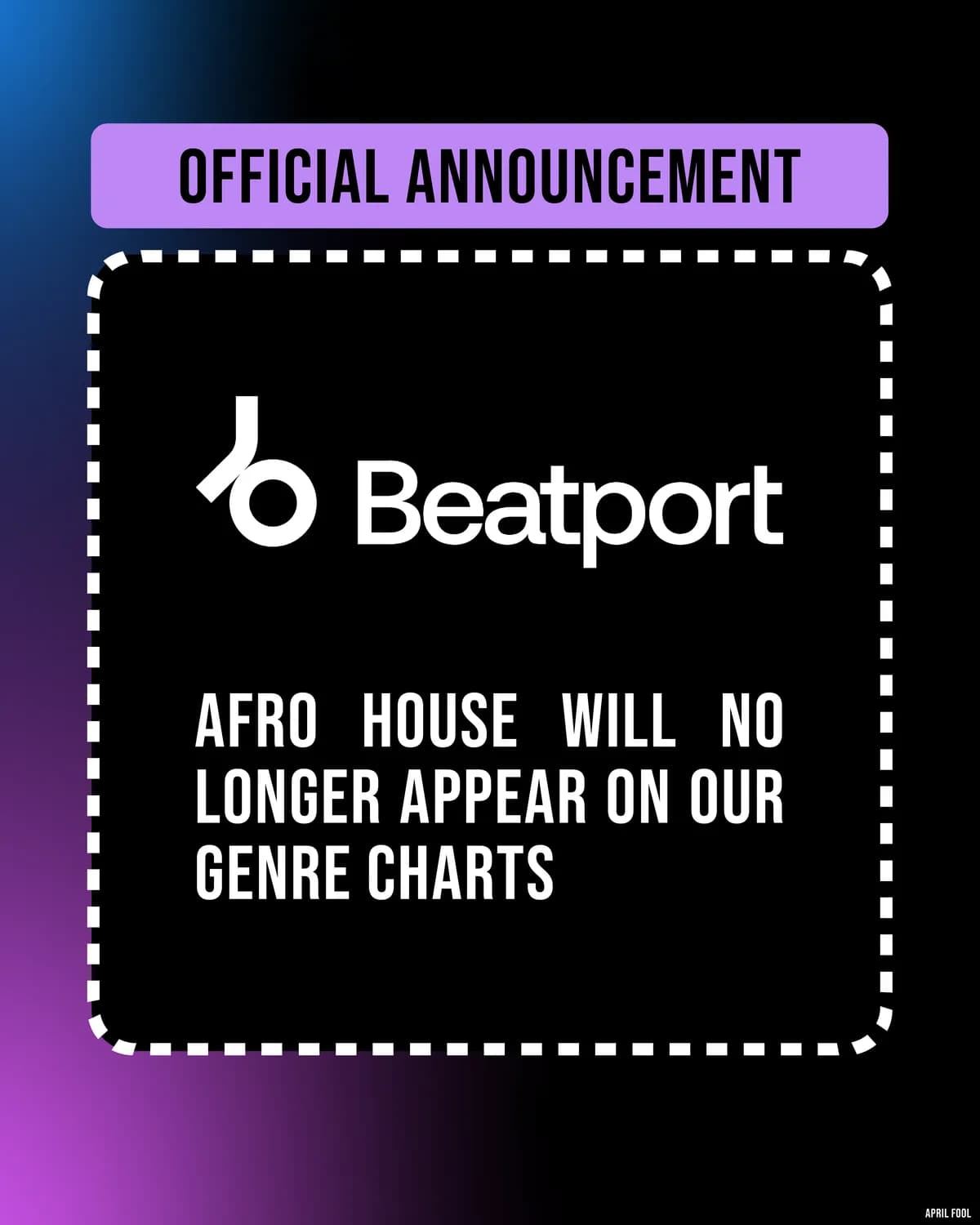
In a move that has sent shockwaves through the electronic music community, Beatport has announced the immediate removal of Afro House from its genre charts, effective April 1, 2026. Citing concerns that the genre has become "too popular for its own good," the platform will reclassify all Afro House releases under a new category: "Mainstream Dance with Organic Percussion."
The decision follows a year in which Afro House downloads reportedly grew 778%, and the genre accounted for 70% of house music’s total growth. A statement attributed to Beatport’s senior genre management team claimed that “underground credibility must be protected, even from the artists who built it.”
The Announcement
In a statement allegedly issued by Beatport’s “Senior Director of Genre Integrity,” the platform announced it would remove Afro House from its genre charts with immediate effect, read in part:
“Afro House has achieved a level of commercial success that is, frankly, uncomfortable for everyone involved. When a genre once discovered by dedicated crate-diggers becomes the go-to soundtrack for sunset Instagram reels, we have a responsibility to intervene.”
Beatport claimed Afro House would no longer appear as a standalone chart category. Instead, all releases would be migrated into a newly created section:
“Mainstream Dance with Organic Percussion” Alphabetically placed after “Trance (Vocal)”.
The statement added that Afro House had not been banned, only “promoted to a category where it can no longer embarrass itself by being popular.”
The Numbers Behind the Decision
The move comes after a year in which Afro House's commercial trajectory became impossible to ignore. According to the MIDiA Research and Splice "Sounds of 2026" report:
-
Afro house downloads grew 778% in 2025, shooting from 760,355 downloads in 2024 to 6,674,943 in 2025.
-
The genre accounted for 70% of house music's total growth in 2025
-
The sample pack "Vocal Afro House" was the fourth most downloaded pack released in 2025, garnering more than 1.4 million downloads
-
Searches grew year over year for other regional subgenres like French house (102%) and Latin house (87%), while subgenres less rooted in specific cultures (like tropical house) saw a 14% drop in downloads
A Beatport spokesperson, speaking on condition of anonymity, said: "We were fine when it was just Black Coffee and a few dedicated heads. Then Keinemusik got involved. Then the sample packs started outselling tech house. Then our own chart algorithm started recommending Afro house to people who had only ever purchased EDM. At that point, we had to ask ourselves: what are we even doing here?"
Read: beatport.com
The New Category
Mainstream Dance with Organic Percussion: The newly created category has already drawn criticism for its vague and somewhat condescending title. A leaked internal memo from Beatport's taxonomy committee reportedly included alternative names such as "House Music That Your Dad Has Heard Of," "Afro House (Derogatory)," and "We Know You Downloaded This for Your DJ Set But Please Don't Tell Anyone."
The "Mainstream Dance with Organic Percussion" category will be housed between "Tech House (Peak Time / Driving)" and "Trance (Vocal)," a placement that one Beatport insider described as "where good genres go to be forgotten."
Beatport is no stranger to controversial genre decisions. In 2016, the platform briefly experimented with merging Deep House and Tech House into a single "Deep Tech" category, a move that was reversed after widespread backlash from DJs who insisted the two genres were "completely different, actually." More recently, in 2022, the platform added a dedicated Afro House chart following sustained pressure from the genre's growing community.
A longtime Beatport user, who asked to be identified only as "DJ Stressed," commented:
"I've been buying music on Beatport since 2008. Every year they find a new way to make genre classification feel like a punishment. Afro house finally gets its moment, and they pull this. What's next? Removing melodic techno because it's 'too sad'?"
The practical implications for Afro house producers are still unclear. Downloads and streams will continue to count toward overall sales, but the removal from dedicated genre charts may affect visibility for emerging artists who relied on chart placement to reach new audiences.
The Official Statement
Beatport's full statement, allegedly posted and promptly deleted (but preserved via screenshot across social media), concluded:
"This decision was not made lightly. We understand that Afro house artists and fans may feel frustrated. But we believe that true underground music should not be easily discoverable. It should require effort, dedication, and ideally, a recommendation from someone who runs a small label out of their apartment in a city you've never visited. By removing Afro house from its chart, we are restoring the natural order: music should be hard to find, hard to categorize, and harder to explain to your friends."
The statement ended with: P.S. April Fool.
The Punchline
Beatport confirmed that the announcement was, in fact, an April Fool's Day prank. The "Mainstream Dance with Organic Percussion" category will not be implemented. Afro house will remain on the charts. The genre is, for now, safe.
The prank announcement was accompanied by a new graphic showing the Afro house chart replaced by a single entry: "April Fool (Original Mix)." The caption read: "We love Afro house. We love that you love Afro house. Please keep making it popular. That's the whole point."
While the announcement was a joke, the conversation it provoked was real. Afro house's explosive growth in 2025-2026 has raised genuine questions about how underground genres navigate commercial success without losing their identity. The genre's roots in South Africa, its pioneers like Vinny Da Vinci and Black Coffee, and its cultural significance are not diminished by mainstream attention but the tension between accessibility and authenticity remains.
Beatport did not remove Afro house from its charts. The genre continues to dominate dancefloors, streaming playlists, and sample pack downloads. Keinemusik will keep selling out stadiums. Black Coffee will continue to be Black Coffee. And somewhere, a producer is adding djembe samples to a tech house track and trying to figure out what genre to call it.
April Fool.
Afro house is fine. Go stream some.
Listen to Afro house: start with Black Coffee, Keinemusik, Francis Mercier
Support South African house music: it's been here the whole time
NOTE: This is a fictional scenario written by Loopliner as an April Fool’s satire
Read Next


Stay in the loop
Asian electronic music, weekly