
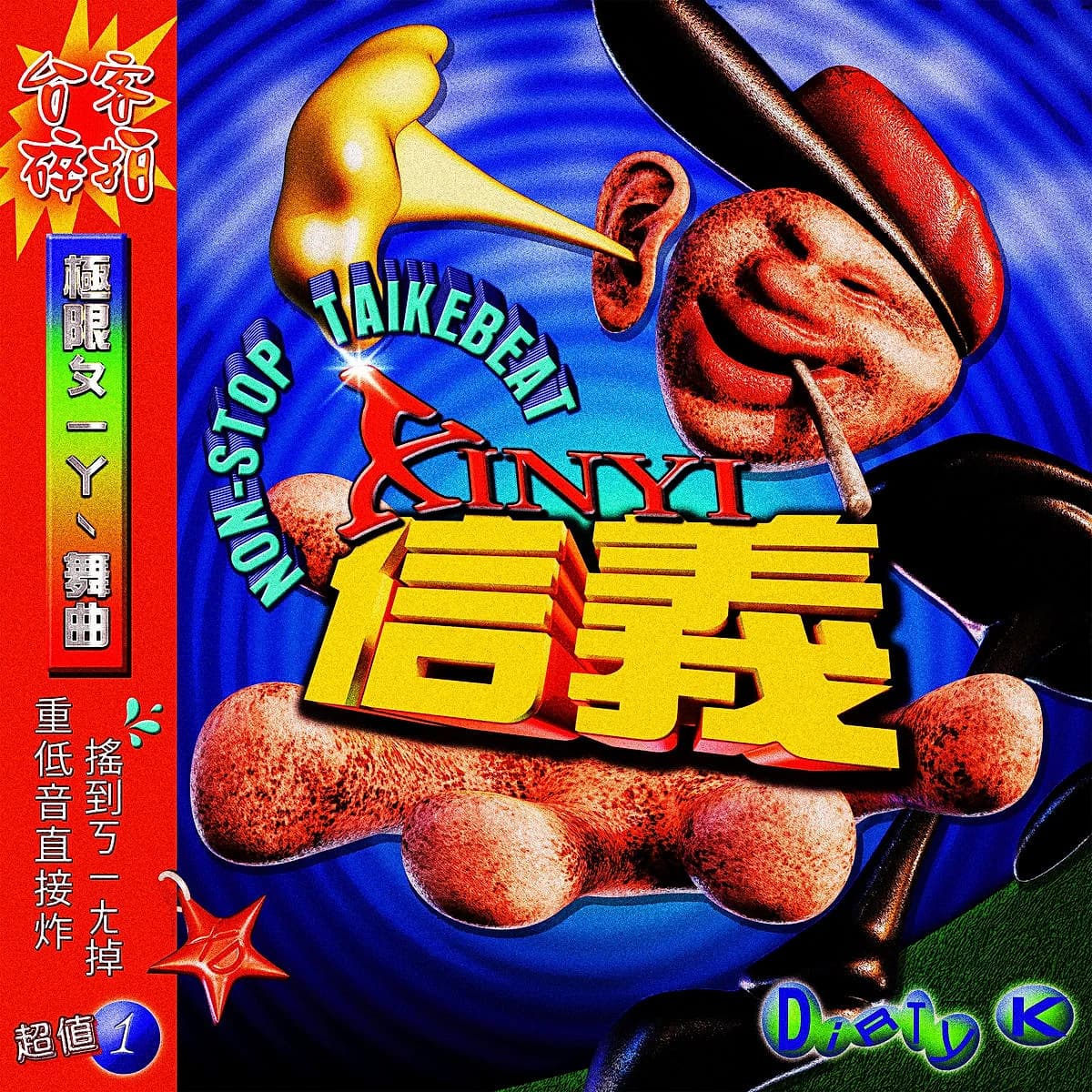
Dirty K Named Taiwan's Banned Rave Sound Taikebeat. DJ Love Remixed It.
A Nanjing producer just coined a name for the sound Taiwan's police raids tried to erase. A Filipino Budots pioneer signed on to remix it, and the pairing says more about Eastern Margins than any press release could.
Official link
By the early 2000s, Taiwan's warehouse clubs were shutting down one after another. Police raids on electronic music events had become routine, chasing what local media had started calling 搖頭丸, yaotouwan, literally "head-shake pills," the MDMA that had taken over the island's dance floors. A 2000 rave at Taipei's Mingde Amusement Park pulled a thousand people. Two years later, at a beach rave in Kenting, police detained 500 partiers in a single weekend, more than a hundred of whom tested positive. The dense, distorted, CD-era sound that filled those rooms never really got a name. It just went quiet.
Twenty years on, a producer who has never lived in Taiwan just gave it one.
A Nanjing Producer Names a Sound He Didn't Grow Up In
Dirty K, who records as dirtykkkk and is based in Nanjing, released 信義 Xin Yi on March 18 through the London label Eastern Margins. The liner notes officially coin the term 台客碎拍 (Taikebeat), describing it as "a dance music language born in Taiwan's early-2000s shake-head pubs and nightclub scenes" that "comes from real dance floors, not the internet." The notes name the rooms directly: Taipei's B1PUB, Taoyuan's The Lion King Nightclub, and No.6 in Kaohsiung. Nine tracks, mixed and mastered by Tsui Honagi with cover art by JECI, built from dense fractured drums and the blown-out low end those venues were known for.
It's the second record in what Dirty K calls an East Asian Dance Music project, following 妙義 Myogi. Whether it's fair for an outsider to be the one who finally names a regional sound is a real question, and the album doesn't pretend otherwise. What it does instead is bring in people who actually work inside the scenes it's referencing, which is a better answer than a press quote would be.
A Budots Pioneer Signs On
The clearest example: DJ Love, the Davao City producer who pioneered Budots and whose own crossover into London's underground Loopliner has tracked, turns in a remix of album highlight "光頭 Woodoorave," billed plainly as the DJ Love Budots Remix. It's a logical pairing more than a strange one: two regional dance vocabularies that outsiders spent years writing off as novelty, both built by producers who were documenting their own dancefloors, not somebody else's idea of them. DJ Love's Eastern Margins ties go back further than this one track, as Loopliner reported when his label deal was announced.
Taipei producer Lujiachi, who co-founded the Bass Kitchen-affiliated label 禁 JIN, handles the title track. His version of "信義 Xin Yi" strips out the crowd-noise chaos of the original and lets the melody breathe, closer to what actually got played toward the end of a set than the top of one.
The Case for Taking It Seriously
Skeptics will point out, correctly, that Dirty K didn't live through the raids he's soundtracking, and that a London label putting a name on a Taiwanese sound is exactly the kind of thing that goes wrong. What tips it toward credible rather than opportunistic is the guest list. Neither Lujiachi nor DJ Love needed the co-sign. Lujiachi already runs a label out of Taipei. DJ Love already has his own deal with Eastern Margins and a catalogue of Budots reissues to his name. Their presence here reads less like outsider tourism and more like two adjacent regional scenes, Philippine and Taiwanese, recognizing something of themselves in each other through a shared label.
That's the part worth watching. Eastern Margins has spent several releases now treating East and Southeast Asian club music as one continuous conversation rather than a set of separate regional curiosities, Budots reissues sitting next to a document of Taiwan's banned rave scene, remixed by people who actually have skin in both games. For a Southeast Asian audience that has watched its own genres, Budots included, get exoticized by outsiders before, Taikebeat is worth watching for how it's handled from here, not just for how it started.
信義 Xin Yi is out now on Bandcamp, eight pounds for the full nine tracks including all four remixes.
Cover art: JECI, courtesy of Eastern Margins and dirtykkkk.
Read Next

Noisia Split on September 17, 2019. They Just Reunited on the Same Date, Seven Years Later.
Inside Siam Modular, the Chiang Mai Workshop Where Red Drum Builds Thailand's First Eurorack Synths

ThaiBeats: Thailand's Ministry of Culture Just Backed a Vinyl Record for Sunju Hargun and 11 Producers
Stay in the loop
Asian electronic music, weekly