

Southeast Asia Has No Pill Testing at Festivals. Wonderfruit's Own Rules Show What You Get Instead.
No government-sanctioned drug-checking service operates at any Southeast Asian festival. Here's what the region's death penalty laws, Wonderfruit's own rulebook and the 2024 Vang Vieng methanol deaths actually mean for anyone going out.
Fifteen grams of heroin, about a tablespoon, is enough to put you on death row in Singapore. Fifteen grams of cannabis in the same country creates a legal presumption that you were trafficking it, before anyone asks who your friends are. Southeast Asia's festival season runs on some of the harshest drug laws on earth, and almost none of its biggest events run any kind of medical safety net for the people who take the risk anyway.
This isn't a guide to what to take. It's a guide to what happens if something goes wrong, legally or physically, at a festival in this part of the world, and what little you can actually do about it.
The Law Is the First Risk You Take
Singapore has the most exact numbers on paper, which somehow makes it scarier, not less. Under the Misuse of Drugs Act, 2 grams of heroin creates a legal presumption of trafficking, and 15 grams makes you eligible for the death penalty regardless of what you say your intent was. The same structure applies to methamphetamine (25 grams presumed trafficking, 250 grams death-eligible) and cannabis (15 grams presumed trafficking, 500 grams death-eligible). Harm Reduction International's 2024 global overview counted eight people hanged for drug trafficking in Singapore between August and November of that year alone; drug offenses accounted for 89 percent of the country's known executions.
Indonesia doesn't publish thresholds as cleanly, but the outcome rhymes: the same HRI report found drug offenses account for 94 percent of the country's confirmed death sentences. Vietnam's courts hand down the majority of their confirmed death sentences for drug crimes too, and HRI notes that any apparent decline in numbers there is more likely a monitoring gap than a policy shift, meaning the real figure is probably higher than what gets reported. Vietnam goes a step further than most of its neighbors on enforcement: according to the UK Foreign Office's current travel advice, "a positive result, regardless of whether drugs were consumed in Vietnam or before entry, may result in criminal charges," meaning having a substance in your bloodstream, not just in your bag, can be the offense.
Malaysia softened its stance in 2023, removing the mandatory death sentence for trafficking and giving judges discretion, but the penalty itself is still on the books. Thailand occupies an odd middle ground since legalizing cannabis in 2022: the same UK travel advisory states plainly that "possessing Class A drugs can lead to the death penalty," and separately warns that detainees in Thai custody face conditions that are "harsh, with limited access to healthcare." The Philippines abolished the death penalty in 2006, but its own drug war under former president Rodrigo Duterte turned extrajudicial violence into a different kind of risk entirely, one that never shows up in a sentencing table. Cambodia isn't broken out individually in HRI's 2024 dataset at all, which is its own kind of warning: an absence of data is not the same thing as an absence of risk.
No Pill Testing Anywhere in the Region
None of that legal pressure comes with a safety valve. In parts of Europe, drug-checking services let festivalgoers find out what's actually in a pill before they take it: The Loop in the UK and Energy Control in Spain both run testing tents at major festivals, sometimes with police cooperation, sometimes without. Southeast Asia has nothing comparable. No government-sanctioned or NGO-run drug-checking service operates at any festival in Thailand, Indonesia, Vietnam, Malaysia, the Philippines or Singapore, and none of the region's flagship events publicize one.
Wonderfruit's own FAQ is a useful case study, mostly because it's unusually specific for the region. It permits "a palm-sized amount" of weed "for personal use," a direct legacy of Thailand's 2022 cannabis law, but treats everything else the way its neighbors do: "narcotics and illegal drugs" are confiscated if found, and "large amounts will be referred to police." Everyone gets searched at the gate, and the same FAQ notes that "food will be confiscated and drinking flasks will be emptied." Nowhere in the document is there a testing kiosk, an amnesty bin, or a medical service geared specifically toward substance use, the kind of thing a UK festival of comparable size would list as a matter of course. If you show up with something you weren't supposed to bring, the stated policy is to take it away and, past a certain amount, hand you to the police. That's the regional default, not an outlier, and it's worth knowing before you buy a Wonderfruit ticket or any other in the region.

When the Danger Isn't the Pill, It's the Bottle
Sometimes the more dangerous product isn't a controlled substance at all. In November 2024, six tourists, two Australians, two Danes, a Briton and an American, died after drinking free shots handed out at a hostel bar in Vang Vieng, Laos. The cause was methanol-tainted Tiger Vodka and Tiger Whisky; as little as 30 milliliters of pure methanol can be fatal. It took until December 1 for Laotian authorities to shut down the factory that produced it and arrest its owner, by which point the deaths had made international headlines and several governments had issued formal travel warnings. Vang Vieng isn't part of the region's festival circuit, it's a backpacker town, but the underlying failure travels further than that one bar: cheap, unregulated spirits circulate widely across Southeast Asia's nightlife economy, and there's no consumer-facing testing system that would flag contamination before it kills someone.
What Harm Reduction Actually Looks Like Here
None of this means there's nothing you can do. The advice that actually reduces deaths at festivals isn't secret, it's just rarely printed anywhere near the gate in this region. DanceSafe, the harm reduction nonprofit whose booths (like the one below, at a US festival) are a fixture on the American circuit, keeps its list blunt: never use alone, tell a friend what you've taken and how much, and remember dosing only goes one direction, in the group's own words, "you can choose to consume more but you can't choose to take less once you have already put a substance in your body." On hydration, its advice cuts against the instinct to just keep drinking water: about a bottle an hour with electrolytes, not more, since overdoing it causes hyponatremia, which is its own medical emergency. Mixing depressants with stimulants, or either with alcohol, is usually where a survivable night turns into an ambulance call.
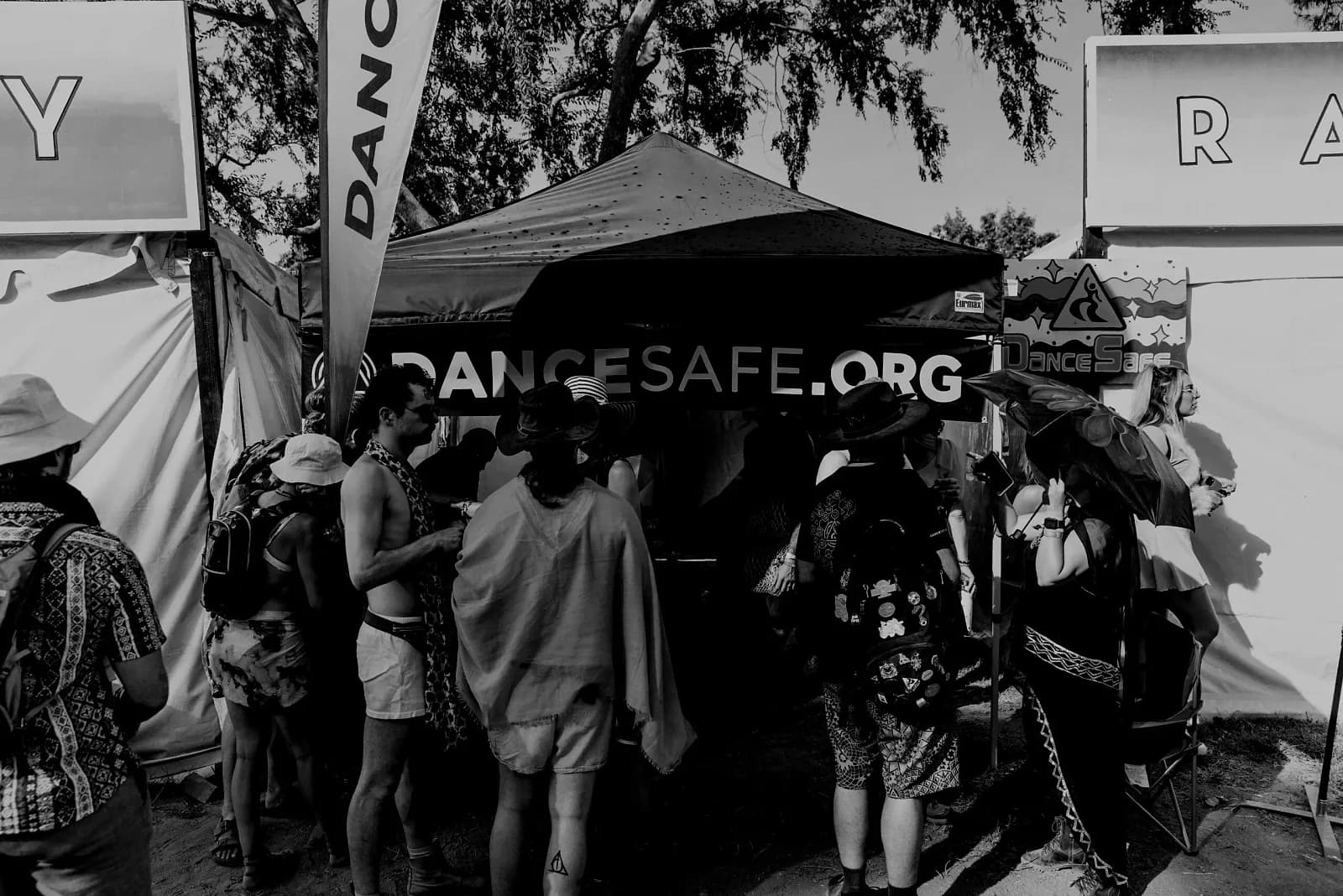
None of that changes your legal exposure. A friend calling an ambulance in Bangkok or Jakarta isn't shielded by a Good Samaritan law the way they might be in parts of Europe or North America, so plan around that reality rather than around the one you'd prefer. If you're heading to a festival in this region, treat the absence of a safety net as the actual policy, not an oversight: know where the nearest hospital is, save your embassy's emergency line before you land, and don't assume a small amount is automatically a safe amount just because a sentencing threshold exists on paper. It's also worth buying your ticket through a verified channel in the first place; a scalped or counterfeit ticket is its own way to end up dealing with police at a gate you didn't need to.
FAQ
Is there pill testing at any Southeast Asian festival?
No. No government-sanctioned or NGO-run drug-checking service operates at Wonderfruit, DWP, EDC Thailand, ZoukOut or any other major festival in the region, unlike the UK or Spain, where groups like The Loop and Energy Control run testing tents.
Which Southeast Asian countries have the death penalty for drug offenses?
Singapore, Indonesia, Vietnam, Malaysia and Thailand all retain the death penalty for drug trafficking, though Malaysia removed its mandatory application in 2023, giving judges discretion instead. The Philippines abolished the death penalty in 2006. Cambodia's status isn't clearly documented in Harm Reduction International's 2024 dataset.
What happened in Vang Vieng, Laos in 2024?
Six tourists died in November 2024 after drinking shots contaminated with methanol at a hostel bar. Laotian authorities traced the source to Tiger Vodka and Tiger Whisky, shut down the producing factory and arrested its owner on December 1, 2024.
Does Wonderfruit allow cannabis?
Yes, in a limited way. Its own FAQ permits a "palm-sized amount" for personal use, in line with Thailand's 2022 legalization, but treats other narcotics like the rest of the region does: confiscation on sight, with large amounts referred to police.
What's the most basic drug safety advice for a festival in this region?
Never use alone, tell someone what you've taken, avoid mixing substances (especially depressants with alcohol), and pace hydration at about a bottle an hour with electrolytes rather than drinking continuously, since overhydration causes its own medical emergency.
Cover photo: courtesy of Wonderfruit.
Read Next

What to Actually Pack for Wonderfruit, DWP and Southeast Asia's Other Big Festivals

Wonderfruit Picked December on Purpose: How Monsoon Season Shapes Southeast Asia's Clubbing Calendar
Bangkok's Underground House Scene Explodes: Hard In Zight 3 Festival Brings Raw Hardstyle Energy to AVVE Bar in March 2026
Stay in the loop
Asian electronic music, weekly