
Thailand Arrested a DJ for Working Without a Permit, and Singapore Stopped Issuing Them at All
Thailand arrested an American DJ in Chiang Mai in June 2026, Singapore quietly stopped issuing its performer work pass, and Indonesia raided a Canggu nightclub over the same paperwork. This is the visa and work permit law for foreign DJs, country by country.
In June 2026, Thai police arrested an American DJ in Chiang Mai, accused of working without a permit, Khaosod English reported. It wasn't a one-off. The previous year, four musicians were fined 5,000 baht each and deported for the same violation, according to a Thai visa and labor guide for performers. In September 2026, Indonesian immigration raided a nightclub in Canggu and detained four foreign nationals, among them two DJs, none of whom held a valid work permit.
None of this is secret. It's also almost never mentioned on a flyer. Every major clubbing market in Southeast Asia treats a paid DJ set as work, which means it requires the same immigration paperwork as any other job. The rules differ by country, the enforcement is real, and a surprising number of touring DJs and local promoters still gamble on a tourist visa and hope nobody checks the booth.
Thailand: A Work Permit for Every Paid Set
Thai law draws no line between a headline slot at a festival and a two-hour warm-up at a bar. If the performance benefits a business financially, immigration counts it as work, and work requires a Non-Immigrant B Visa (Entertainer/Artist category), obtained from a Thai embassy or consulate before arrival, not on landing. A tourist visa or visa exemption does not qualify, even for a single unpaid guest set.
The visa application needs a passport valid for at least six months, a recent photo, proof of at least 20,000 baht in funds (40,000 baht if traveling with family), and a letter of invitation from the Thai company booking the performer. Once that's approved, the employer, not the DJ, files the actual work permit with the Ministry of Labour: passport and visa copies, the job contract, and the venue's business registration. Processing usually takes 7 to 10 days, and the applicant has to show up in person to collect it.
Skip the process and the penalties aren't theoretical. Fines can run up to 100,000 baht, on top of detention, deportation and an entry ban, and the venue that booked the act can be fined or shut down too. There's no quiet exception for a single night. A short, one-off, unpaid guest appearance still counts as work under Thai law.

Singapore: The Permit That No Longer Exists
Singapore used to have a dedicated route for this: the Work Permit for Performing Artiste, issued by the Ministry of Manpower to venues holding a Category 1 Public Entertainment Licence. MOM has since ceased the scheme outright. Its own page states it plainly: "We have ceased the Work Permit (Performing Artiste) scheme. Businesses can no longer apply for new foreign performing artistes on this work pass," though holders of existing permits can keep working until those expire.
For a club booking a new international DJ now, MOM points to three alternatives: hire through a licensed entertainment service provider, use a regular work pass instead of a performer-specific one, or rely on the Work Pass Exempt (WPE) framework for short, one-off engagements. The catch is that WPE explicitly excludes bars, discotheques, lounges, nightclubs, pubs, hotels, private clubs and restaurants holding that same Category 1 licence, which is to say, it excludes almost every venue that actually books house and techno DJs. A government-backed festival stage can use it. Zouk can't.
Indonesia: The C7A, and a Raid in Canggu
Indonesia's version is the C7A performer visa, a single-entry visa covering musicians, DJs, bands and dancers booked for a specific engagement, valid for stays of up to 60 days. The Indonesian promoter, venue or agency, not the performer, files the sponsorship paperwork. The government fee runs around IDR 1,500,000, and the guidance is to start the process a couple of weeks before the gig.
Enforcement is active in Bali specifically, where immigration, military police and the national narcotics agency run joint raids on nightlife venues. The September 24, 2026 Canggu raid detained an Egyptian DJ on a Visa on Arrival, two Russian nationals (one on a VOA, one on an investor KITAS) and a Nigerian woman who'd overstayed by 402 days. Authorities hadn't announced final decisions on fines or deportation at the time of the report, but none of the four held a work permit, and immigration officers have previously pulled foreign DJs mid-set while properly documented artists on the same bill kept playing.
Malaysia: Puspal and a Slower Process
Malaysia routes every foreign performance through Puspal, the government body that coordinates applications for foreign artists and crew, before immigration will issue a Professional Visit Pass (PVP). The Malaysian promoter sponsors the application, not the performer, and has to register the event with Puspal first. As of mid-2026, the government fee runs around RM1,296, with separate endorsement fees depending on duration. A PVP can be valid for up to 12 months, though most performers are authorised for around six.
The real obstacle is time, not money. A first-time PVP application typically takes seven to eight months across six processing stages, which rules out booking a touring DJ on short notice. It's one reason Southeast Asia's touring circuit stays patchwork rather than seamless, a gap a venture called Triangle Group is trying to close by routing the same artist across several Asian markets on one tour instead of one-off flights.
What's Not Confirmed
The Philippines and Vietnam almost certainly have their own rules governing paid foreign performers, but no primary source turned up a DJ-specific process worth stating as fact here, and this piece won't guess at one. The same goes for Cambodia, Laos, Myanmar and Brunei. Treat the absence of a country here as a research gap, not a clean bill of health; assume any paid booking anywhere in the region requires some form of authorisation until a promoter confirms otherwise in writing.
FAQ
Do foreign DJs need a work permit to play in Thailand?
Yes. Thai law treats any paid performance as work, requiring a Non-Immigrant B Visa obtained before arrival and a work permit filed by the employer. A tourist visa or exemption isn't sufficient, even for one unpaid guest set.
Can a Singapore club still sponsor a performer-specific work pass?
No. MOM has ceased the Work Permit for Performing Artiste scheme for new applicants. Venues now need a licensed entertainment service provider, a regular work pass, or the Work Pass Exempt framework, which excludes nightclubs and similarly licensed venues.
What visa does a DJ need to play a beach club set in Bali?
Indonesia's C7A performer visa: single-entry, sponsored by the local promoter, valid up to 60 days, and costing around IDR 1,500,000 in government fees.
How long does Malaysia's performer visa take to process?
A first-time Professional Visit Pass, arranged through Puspal, typically takes seven to eight months, which is why last-minute bookings there are difficult.
What happens if a DJ performs without the right permit?
Fines, detention, deportation and entry bans. Thailand fined and deported four musicians in 2025, arrested a DJ in Chiang Mai in June 2026, and Indonesia detained two DJs in a September 2026 Canggu raid.
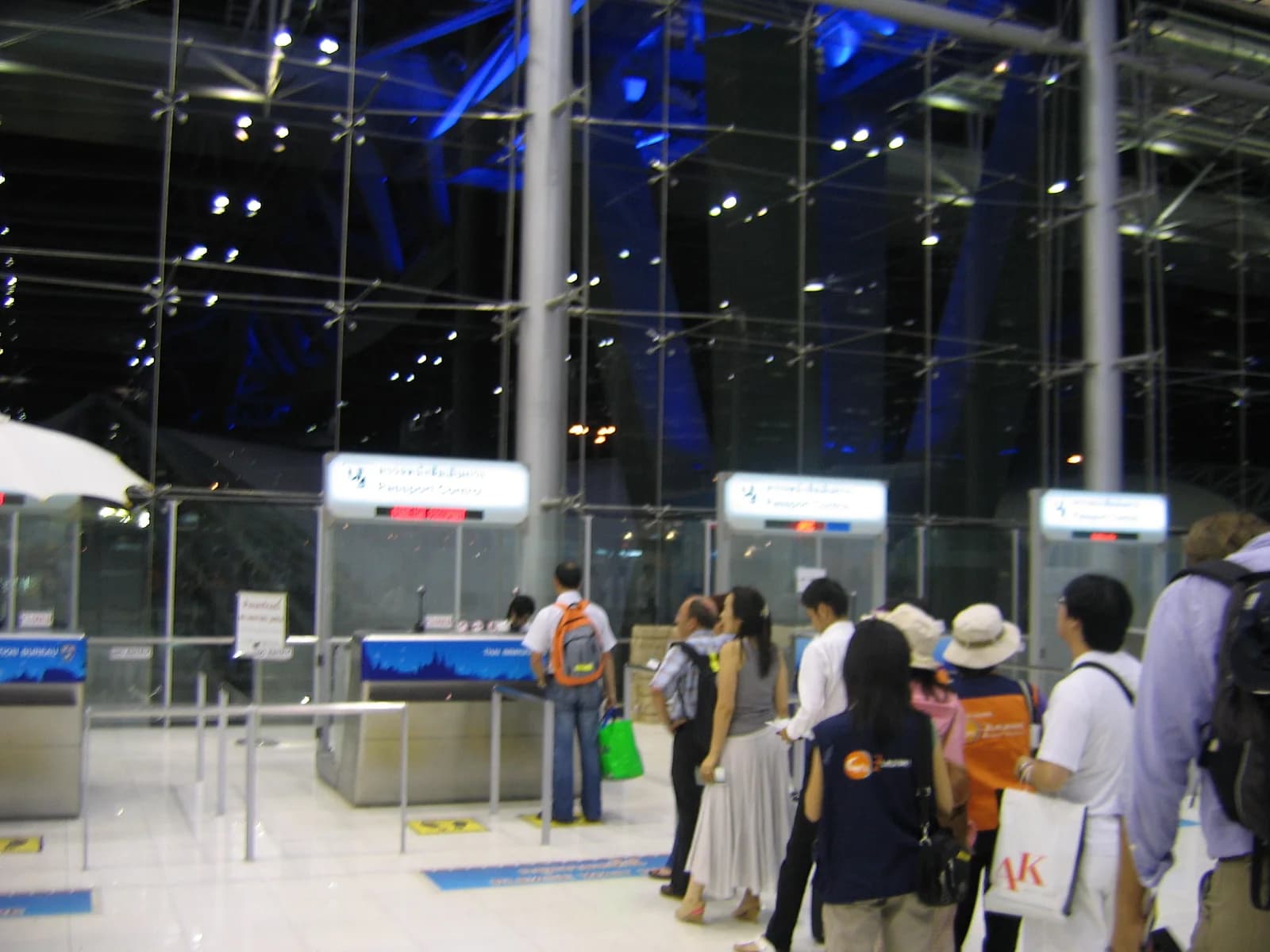
Cover photo: Passport control at Suvarnabhumi Airport, Bangkok. Jarcje, CC BY-SA 3.0, via Wikimedia Commons.
Read Next
Thailand Scrapped Its Decades-Old Afternoon Alcohol Ban: What You Can (and Can't) Legally Drink Across Southeast Asia
Thailand Still Sells Legal Weed With a Doctor's Prescription, While the Rest of Southeast Asia Bans It Outright
Bangkok's Underground House Scene Explodes: Hard In Zight 3 Festival Brings Raw Hardstyle Energy to AVVE Bar in March 2026
Stay in the loop
Asian electronic music, weekly