Reading 808 Festival's Lineup Poster: What B2B, ID and Closing Set Mean
Back-to-back, ID, VIP mix, closing set. A lineup poster is written for people who already know the code, and this glossary breaks down what each term actually means, with real examples from Bangkok to Singapore.
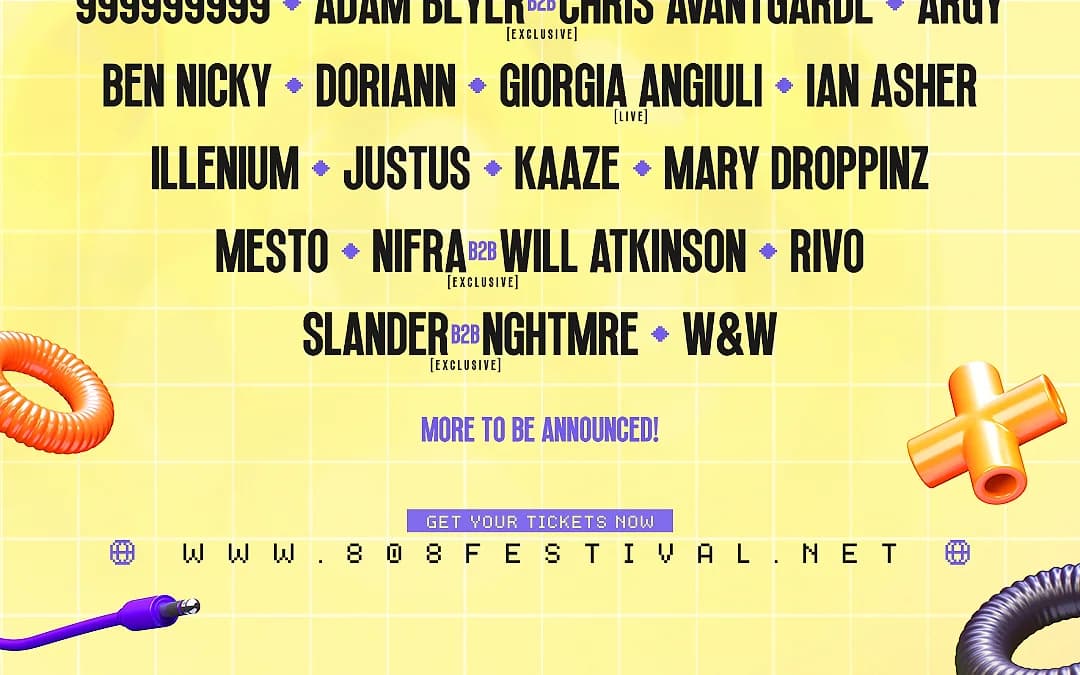
Look closely at 808 Festival's phase-two poster for its October 2 and 3 edition at BITEC in Bangkok and you will spot small bracketed tags sitting under three names. Adam Beyer and Chris Avantgarde share one that reads "B2B [EXCLUSIVE]." Nifra and Will Atkinson get the same tag. Giorgia Angiuli gets a different one: "[LIVE]."
A festival lineup is a dense little document, more code than copy, and the code rewards people who already speak it. This is the glossary for the rest of us: what the abbreviations and brackets on a lineup poster or a tracklist actually mean, term by term.
B2B Means Exactly What It Says
B2B, back to back, means two DJs trading tracks in the same set, usually swapping every song or every few minutes rather than each playing a separate block. It is a format, not a billing gimmick, though festivals have learned it sells tickets: 808 Festival's own poster marks its three B2B pairings "exclusive," meaning nobody else gets that exact combination of names in 2026. We've gone deep on how B2B actually works, who decides the pairing, and why Bangkok keeps booking it, in a separate piece on the format.
ID: The Track Nobody Will Name
ID stands for identification, and it shows up on a tracklist or a lineup caption when a song's artist, title, or both have not been officially announced. Usually it is unreleased music, a dubplate the producer is testing on a crowd months before it has a label, a catalog number, or even a final name. Shazam will fail on it. Asking the DJ afterward sometimes works and sometimes doesn't, since plenty of producers deliberately sit on an ID for a year or more to build anticipation before a release. If you hear something extraordinary in a set and can't find it anywhere online the next morning, that's usually why.
DJ Set vs. Live Set
A DJ set means mixing pre-recorded tracks, whether off vinyl, USB, or a laptop, blending one into the next. A live set, sometimes written "Live" or "Live PA," means the artist is building the music in real time with synthesizers, drum machines, or a laptop running their own production software rather than playing finished records. The skill set is different and so is the risk: a DJ can recover from a bad transition in two bars, while a live performer can watch an entire arrangement fall apart on stage. Posters flag it because audiences show up with different expectations for each.

Warm-Up, Closing, and Everything Between
A lineup isn't just a list of names, it's a shift schedule, and the slot matters as much as the booking. The warm-up or opening DJ plays to an empty or half-full room and has one job: build energy gradually enough that the floor is primed, not exhausted, by the time the next act takes over. It's widely considered the hardest slot to do well and the easiest to do badly, because nobody notices a good warm-up set and everybody notices a bad one.
The closing set is the opposite problem at the opposite end of the night: read a crowd that has been dancing for hours and bring the room down, or keep it peaking, without losing the people who are still there. It's generally treated as the more prestigious slot, since promoters hand it to whoever they trust most to finish what the night started. Marquee Singapore gave its closing slot on October 11, 2026, a Formula 1 weekend date, to Martin Garrix, a door-tickets-only, sold-out room. That's a closing booking functioning exactly as the term implies: the headline slot, not an afterthought.
VIP Mixes, Edits, and Bootlegs
Three more terms that get used loosely but mean different things. A VIP mix, sometimes VIP edit, is the original producer's own reworked version of their track, a heavier or more dancefloor-ready alternate take made for DJs rather than radio or streaming. An edit is a smaller structural change, usually to someone else's track: a trimmed breakdown, an extended intro, a tempo shift for a smoother mix, nothing added that wasn't already there. A bootleg is the unauthorized version: a remix or mashup made and circulated without the rights holder's permission, which is why bootlegs tend to live in DJ pools and private file-sharing groups rather than on streaming services. The difference between an edit and a bootleg comes down to permission, not how much was changed.
The Secret Set
Festivals and clubs occasionally book a slot under "Secret Guest," "???," or a time-only placeholder with no name attached. Sometimes it's a genuine surprise booking revealed on the night. More often it's an artist whose own schedule, label, or exclusivity deal won't let their name appear on a public poster until the show itself. Boiler Room's entire original format grew out of a related idea, stripping away the production and distance of a normal club broadcast so a set feels like something you're watching happen rather than something staged for you. We've written about how Boiler Room actually books a show, including the grant program some Southeast Asian artists have used to get one.
None of these terms require insider access to learn. They just aren't printed on the poster, which is the whole point of a glossary.
FAQ
What does B2B mean on a DJ lineup?
B2B, short for back to back, means two DJs sharing one set and trading tracks, usually every song or every few minutes, rather than playing separate blocks.
What does ID mean in a DJ set or tracklist?
ID means the track's artist, title, or both haven't been officially revealed, which usually happens because the music is unreleased and the producer is testing it ahead of a formal release.
What's the difference between a DJ set and a live set?
A DJ set mixes pre-recorded tracks together. A live set, often marked "Live" on a poster, means the artist is building the music in real time with synths, drum machines, or production software rather than mixing finished records.
What does VIP mix mean?
A VIP mix is the original producer's own alternate, dancefloor-focused version of their track, distinct from a remix made by someone else or an unauthorized bootleg.
Why is the closing DJ slot considered important?
The closing set is handed to the DJ a promoter trusts to read an exhausted crowd and bring the night to its best possible finish.